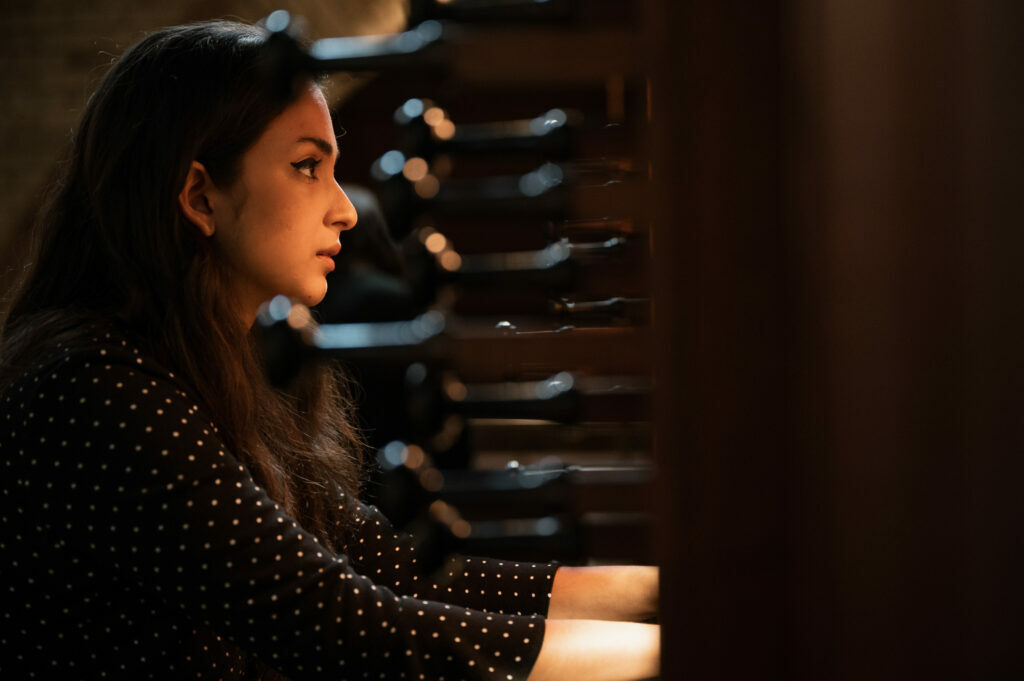
Maria Gajraj brings together the many voices of the organ : the contemplative world of sacred music, the grandeur and colour of the Romantic tradition, the spare intensity of minimalism, and the adventurous soundscape of contemporary music. Her programme moves freely across centuries, revealing unexpected connections between music rooted in ancient traditions and works that stretch the organ into new sonic territory.
In Maria's hands, the organ becomes both familiar and surprising : capable of profound stillness, luminous textures, rhythmic energy, and vast orchestral colour. Her playing invites us to hear an instrument with centuries of history not as a relic of the past, but as a vibrant and expressive voice today.
Maria Gajraj is an organist, writer, and sound creator, named one of CBC’s “30 Hot Classical Musicians Under 30” in 2026. She has performed internationally; including concerts across Canada, the USA, the UK, France, the Netherlands, and Norway. Maria’s debut album, “exhale.”, was released in May 2025. A recipient of the Godfrey Hewitt Scholarship (2022), Maria was the most recent First-Prize Winner of the RCCO Canadian National Organ Competition (2025).
Maria received her Doctorate of Music from McGill University in 2026. Her doctoral research focused on the music of Edward Margetson, a 20th-century Caribbean organist and composer who campaigned for racial equality through his writings and music. Her research has been published in the UK-based “Organist’s Review.”
Maria is also the production director and organettist for the medieval Ensemble COMTESSA, winner of the 2025 “Emerging Artist Award” from Early Music America. As of Fall 2026, Maria is the Music Director of St Philip’s Anglican Church in Vancouver.
In her concert programs, Maria is passionate about highlighting women and composers of colour. Her performances have been hailed as “spirited, clean, and colourful, lending real meaningful significance” to this music (Deirdre Piper, Pipelines.) By creating engaging concert programs, and by featuring the organ in innovative and multidisciplinary contexts, Maria strives to break stereotypes, and to make the organ more accessible to everyone.